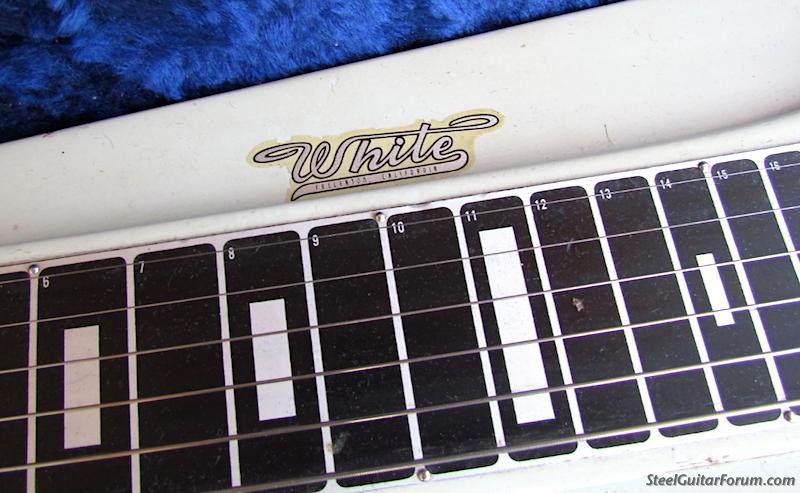
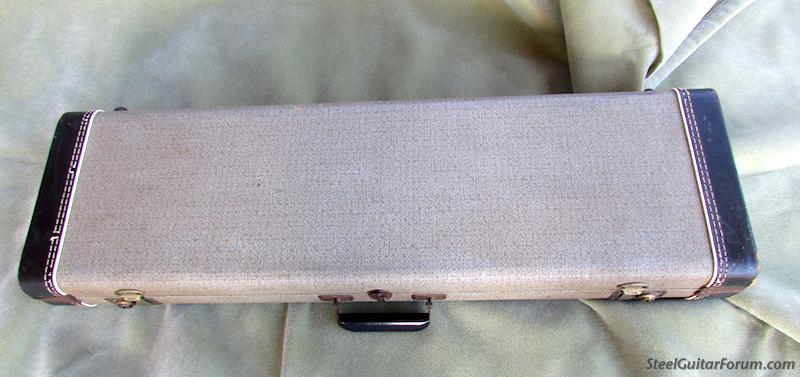
Friends: I recently purchased a 1950s Fender "White" consolette lap steel.
From what I've been able to scrounge on the net, it appears they're just Studio Deluxe models under a slightly different name.
This little trick was a not-so-subtle way of selling Fender gear to non-Fender accounts without (ostensibly) pissing off local Fender dealers. It was also a way of paying tribute to Fender production manager Forest White.
So, my question: Do I have it right? Can anyone add to this?
Sure wish I had the White amp that came with this guitar!
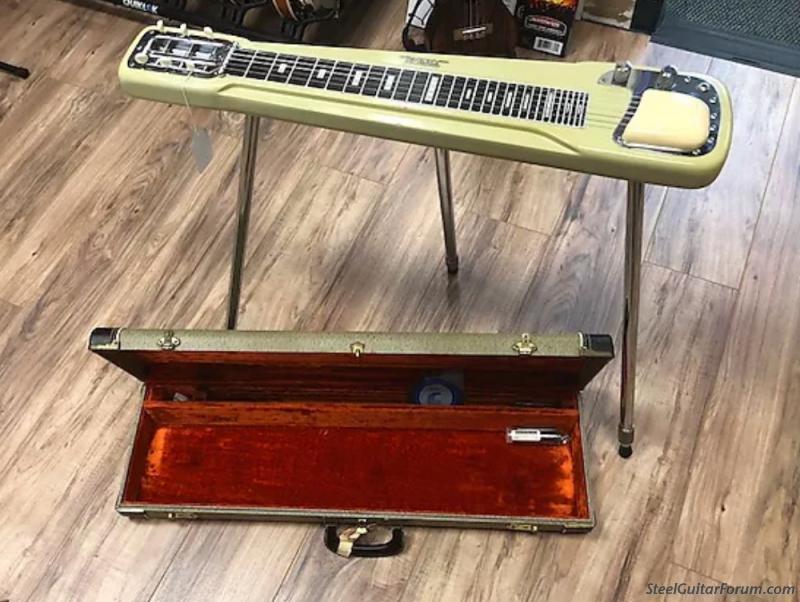
Here's a pic of the guitar:
Last edited by Mark Helm on 24 Mar 2018 2:22 pm, edited 2 times in total.
Remington Steelmaster S8 w/ custom Steeltronics pickup. Vox MV-50 amplifier + an 1940's Oahu cab w/ 8" American Vintage speaker. J. Mascis Fender Squire Jazzmaster, Hofner Club bass, Ibanez AVN4-VMS Artwood Vintage Series Concert Size Acoustic Guitar. 1920s/30s Supertone Hawaiian-themed parlor guitar. Silvertone parlor guitar.
You're right, it's basically a Studio Deluxe with a "White" logo, marketed to music stores that were not Fender dealers. I've owned three of them, and to my ear, they all sounded thin and shrill. I couldn't get any warmth in the tone regardless of how a set my amp(s).
I remember brief mention of this brand in one of my Fender books somewhere, and you're right about the Forrest White connection. I think they were basically meant as student outfits.
Here's what Forrest White says in his book, p. 89:
In early 1955, I was in the woodshop in Building #3, and an employee from the stockroom came in and asked me what I wanted him to do with the "White" nameplates that just came in. I said, "If they are white, send them back because our nameplates are brown and chrome."
He said, "No, you don't understand; they are 'White.'"
And I guess I must have looked at him a little strange when I replied, "Look! I just told you if they are white to send them back."
Then he said, "Here, look at what I'm talking about." The name on the nameplate was White.
That was when and how I found out that Leo had used my name for the new line of "studio" guitars and amplifiers intended for music studios (not regular dealers), where students were taught to play instruments. The tube charts to be placed inside the amplifier cabinets said "White Instrument Co., Fullerton, California." Leo had not said anything to me about naming the line after me. I had been purchasing all of our manufacturing parts and material for a long time. Leo had ordered the name-plates and labels and must have told the supplier not to tell me because it was a surprise.
I have the first White amplifier that was made in early 1955. It is still in the original carton and has never been opened. I also have a White steel guitar with legs. We received the first Fender Sales Purchase Order #402 for the new studio line, White Amp Model 80 and 6-String Steel, on September 13, 1955. We made those units in October/November.
Here's one of the White steels I had a few years ago. It was basically a student grade guitar (similar to a Champ) with legs.
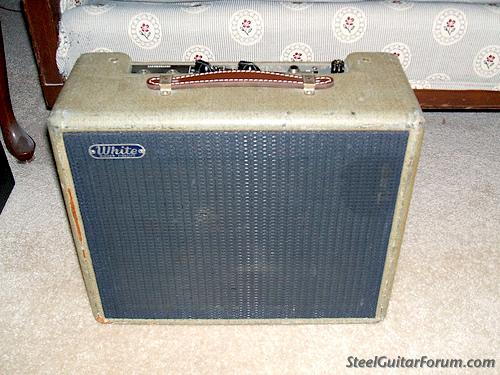
They were originally sold with a matching White amp, which was similar to the tweed Princeton. The amps are worth two to three times more than the guitars today. There's one on Reverb now with an asking price of $2K.
I had a matched set. The amp was pretty cool, kind of like a tweed Princeton. It touted “Higher Fidelity “, which it didn’t have!
I sold the pair to the guitar player from the Counting Crows for stupid money.
I sold the pair to the guitar player from the Counting Crows for stupid money.
Interesting. I sold mine to one of the luthiers at the Fender Custom Shop. He was thrilled to get the guitar and show it to his fellow builders at Fender.
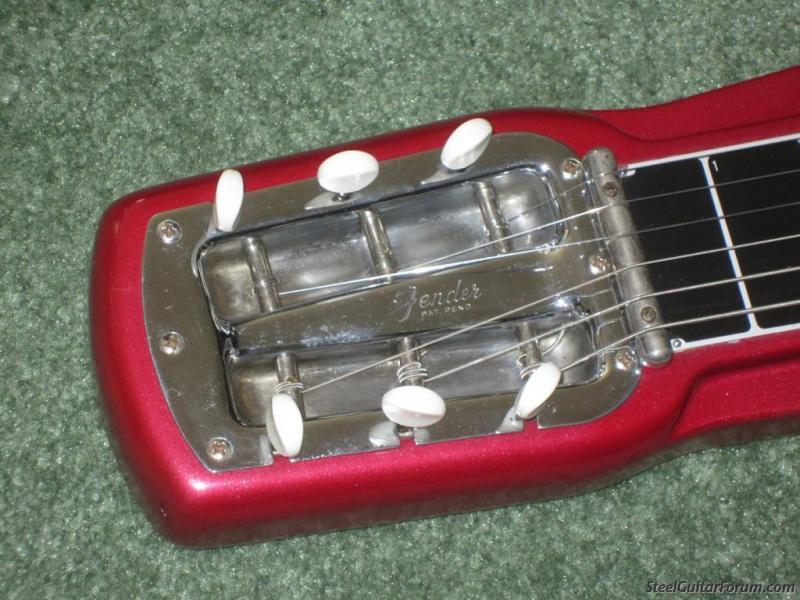
The tuner pan on my Studio Deluxe is different from the tuner pans on the Whites in the above pix. As a consequence, the two models have differently shaped headstocks. The White's is more squared-off, and my Studio Deluxe is more of a snakehead. Aside from that, the two models are very similar.
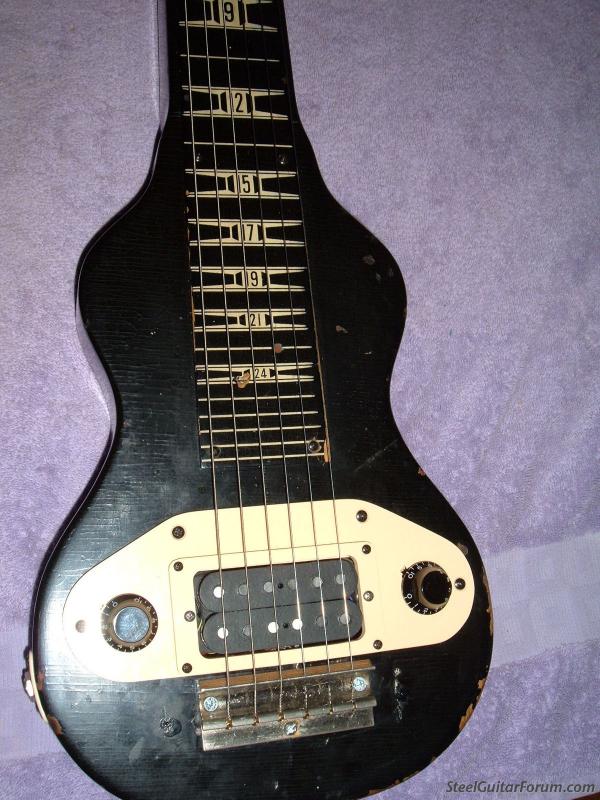
I had a White lap steel for a while, in the 80s. The paint had been stripped from it - I think it was walnut. One really nice feature was little numbers on the frets. I don't think any other Fenders had that.
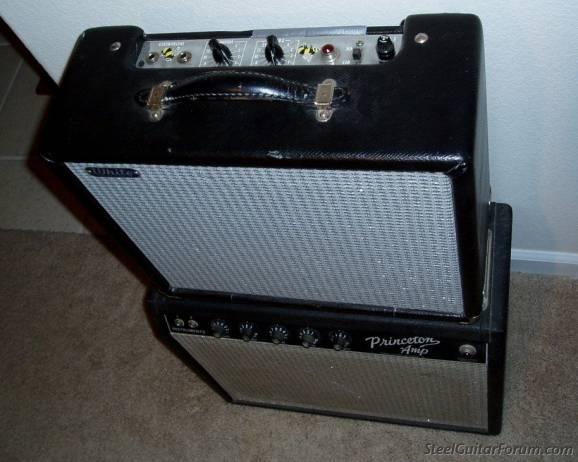
More recently, I was caretaker of a White amp for a few years. It had a really bright sound, not very usable for steel IMHO. Here are a couple of pictures of it, stacked on my Princeton.
Doug Beaumier wrote:The Fender Champ also had numbers on the frets. So did the Gibson BR-9, both considered student grade lap steels when they were made.
My Fender Studio Deluxe has small numbers on its fretboard. I suspect it's exactly the same as the Champ fretboard:
The first version of the Gibson BR-6 (the black ones) also had a numbered fretboard:
When the BR-9 was introduced and superseded the BR-6 as Gibson's student model, the BR-6 was upgraded to a sunburst finish and its numbered fretboard was changed to a more traditional design.
I was wrong. Maybe the lap steel I had was a Fender Champ. The paint was stripped from it so no decal. Were the Champ and the White both made of walnut?
I really liked the small numbers on the fretboard. Subtle, elegant and helpful.
I JUST purchased a Studio Deluxe as well from the same time period, so we'll see if the White sounds "shrill" in comparison. I would be a bit surprised because they're the same pickups wired by the same employees back in the mid-50s, but who knows.
Maybe it was what you were eating back then, D.B.!
Anyway, fellers--thanks for all the info. I'll fill ya in and send some better pics when it arrives.
Remington Steelmaster S8 w/ custom Steeltronics pickup. Vox MV-50 amplifier + an 1940's Oahu cab w/ 8" American Vintage speaker. J. Mascis Fender Squire Jazzmaster, Hofner Club bass, Ibanez AVN4-VMS Artwood Vintage Series Concert Size Acoustic Guitar. 1920s/30s Supertone Hawaiian-themed parlor guitar. Silvertone parlor guitar.
Mark Helm wrote:Who did the paint job on your Fender lap?
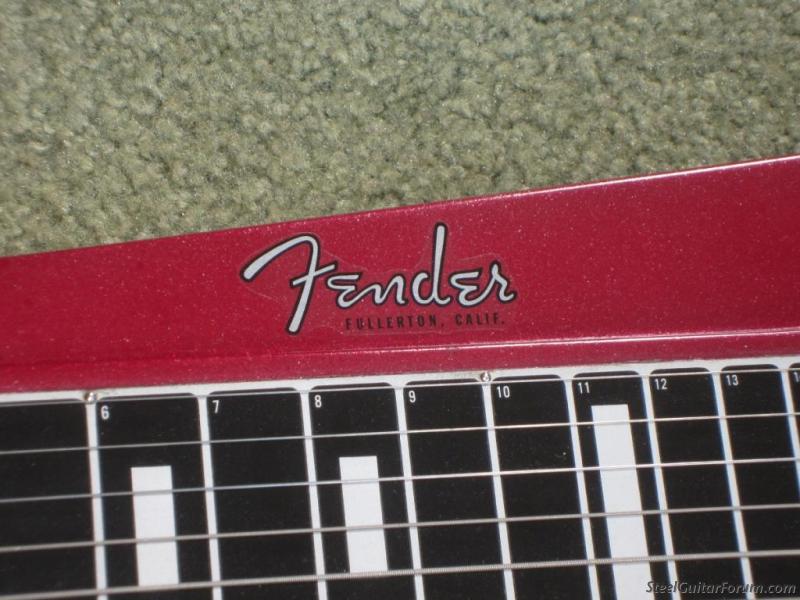
It was painted metallic candy apple red when I purchased it as a carcass from an eBay seller a few years back. Not sure who painted it, but no question it's post-Fullerton. Whoever it was did an adequate job, but it's definitely a notch or two down from a truly professional-grade finish.
The pickup and all the electronics had been stripped out, so I ordered & installed a Strat-style pickup with a flat (unradiused) blade polepiece and AlNiCo V magnets from Vintage Vibe. It sounds good -- much better than any of the Champ-type instruments with stock Fender pickups that I've ever had the chance to play. As noted by Doug and others, the stock instruments can be rather weak and thin-sounding.
It functions as my "road" guitar, in that it rides in my vehicle along with a Roland battery-powered amp for impromptu playing situations that may develop during my travels.
Bob: Yes and no (and I know the guys will correct me if I'm wrong): I believe the majority of 50s Fender lap steels were made of either Walnut or Ash, whether they be the Whites, the Studio Deluxes, or the Champs.
Anyone know more on this?
I'd strip mine down, but, well...you know.
Remington Steelmaster S8 w/ custom Steeltronics pickup. Vox MV-50 amplifier + an 1940's Oahu cab w/ 8" American Vintage speaker. J. Mascis Fender Squire Jazzmaster, Hofner Club bass, Ibanez AVN4-VMS Artwood Vintage Series Concert Size Acoustic Guitar. 1920s/30s Supertone Hawaiian-themed parlor guitar. Silvertone parlor guitar.
It KILLS me that so many of these 50s Fender lap steels have been stripped down for parts. I had a guy trying to sell me a neck he "harvested" from a quad Stringmaster. I wish it was more highly frowned upon.
Remington Steelmaster S8 w/ custom Steeltronics pickup. Vox MV-50 amplifier + an 1940's Oahu cab w/ 8" American Vintage speaker. J. Mascis Fender Squire Jazzmaster, Hofner Club bass, Ibanez AVN4-VMS Artwood Vintage Series Concert Size Acoustic Guitar. 1920s/30s Supertone Hawaiian-themed parlor guitar. Silvertone parlor guitar.
Is there a specific reason Fender put the tuners in a "pan"?
It seems like an expensive way to mount 6 tuners.
Was it done for the cool factor, or did it actually help in some other way?
The dies involved in stamping and forming those pans were not cheap to produce I can assure you. I was in that business for 37 years.
I guess I would like to know, if mounting tuners in a "pan" is superior to just using the wood body as your mount?
Currently own, 6 Groner-tone lap steels, 1953 Alamo Lap steel, (a gift from the late Stu Schulman) Recording King Phil Leadbetter Dobro, Roland Cube, Roland Mobile Cube, Fender Champion 40
Someone may have a much better answer than me about the tuner pans, but it seems that Fender's basic philosophy around guitar construction was to make everything modular, bolt-on (screw-on really), easy to swap in and out, and assembly-line oriented - while minimizing craftsmanship stuff like gluing, binding. I guess in Fender's and his designers minds a bin full of assembled tuner pans that just needed 6 wood screws to install was simpler and faster on the assembly line than somebody installing individual tuners into the guitar via some means. And if you're going to do routing its probably simpler to have one large square-ish route that you just drop a pan into than to try to do more precise "slots" (a la Console Grande maybe?). Also you could use the same guitar necks with the same routed cavities to build either 6 or 8 string guitars simply by choosing the 6 vs the 8 string version of the tuner pans and nuts/bridges, based on demand/sales of each one. If you got the parts you could even upgrade a guitar from one to the other pretty easily. And the way the early pans were built such that it was almost impossible to replace or fix a single tuner the thinking was probably that if a tuner goes bad you just pull out the whole pan and replace it. Which Fender apparently did routinely for some of the big stars. The problem being that eventually by the mid-late-50s the early dual-pro and long-scale SM style pans were no longer being made by or for Fender and the supply dried up.
You see similar philosophy with the Spanish guitars. Fender was reluctant to put a truss rod into the Broadcaster for some reason, and with the bolt-on neck he just thought if anything happens we can just swap in a new neck, throw away the old one. Fender had somewhat different ideas about how and why people should use his products than what turned out to be the reality.
Brad, thanks for the post. I think that was a great answer. Looking forward to opinions from some other guys.
Currently own, 6 Groner-tone lap steels, 1953 Alamo Lap steel, (a gift from the late Stu Schulman) Recording King Phil Leadbetter Dobro, Roland Cube, Roland Mobile Cube, Fender Champion 40
In about a week, after I have mine thoroughly checked out and fully cleaned up, I will be listing it here in the classifieds if anyone is interested ( and for less than the legless one above).
Finally, I'm not having any problems with the sound on the guitar at all; it sounds pretty full, just using my little Vox AC10 tube amp w/ a splash of reverb. However, by the time I have this ready to post, my "new" '58 Fender Champ will have arrived, and I'll be able to A/B them for a more full report.
Keep steelin'!
Last edited by Mark Helm on 24 Mar 2018 2:26 pm, edited 1 time in total.
Remington Steelmaster S8 w/ custom Steeltronics pickup. Vox MV-50 amplifier + an 1940's Oahu cab w/ 8" American Vintage speaker. J. Mascis Fender Squire Jazzmaster, Hofner Club bass, Ibanez AVN4-VMS Artwood Vintage Series Concert Size Acoustic Guitar. 1920s/30s Supertone Hawaiian-themed parlor guitar. Silvertone parlor guitar.
Mark Helm wrote:...by the time I have this ready to post, my "new" '58 Fender Champ will have arrived, and I'll be able to A/B them for a more full report.
That's great. Anxious to see the report.
A special item of curiosity would be whether the Champ and the White are the same thickness. In the back of my mind there's the notion that the White and the Studio Deluxe have thicker bodies to accommodate their leg sockets.